
Catholic Church Argues for Exception to Employee Rights at Seventh Circuit – Courthouse Information Service

Related Posts
A Catholic church in the Chicago area argued in the federal appeals court for its religious right to treat ministerial employees at will, including dismissing them on otherwise discriminatory grounds.
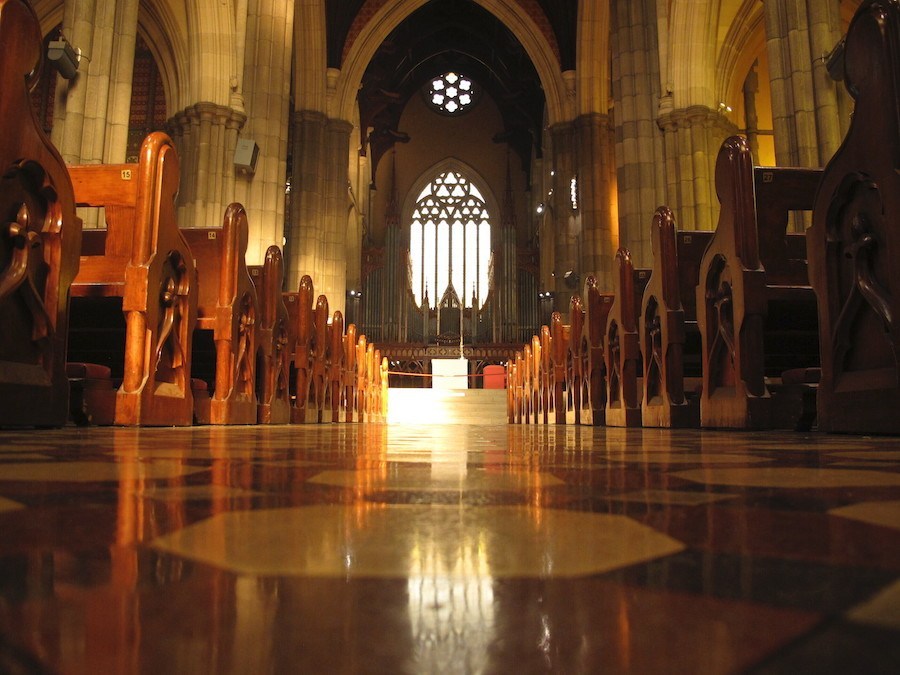
 100vw, 900px “data-lazy-src =” https://i0.wp.com/www.courthousenews.com/wp -content / uploads / 2019/08 / cathedral .jpg? resize = 900% 2C675 & is-pending-load = 1 # 038; ssl = 1 “srcset =” https://www.courthousenews.com/data:image/gif;base64,https://www.courthousenews. com / R0lGODlhAQABAIAAAAAAAP /// yH5BAEAAAAALAAAAAABAAEAAAIBRAA7 “/> (AP Photo / Rod McGuirk, file)</p><p>CHICAGO (CN) – The Catholic Archdiocese of Chicago stated in an appeals court hearing Tuesday that it had the right to treat certain employees as it sees fit, even though that behavior would be discriminatory in a secular workplace.</p><p>Before an en banc 10 judge panel in the Seventh Circle, the church fought against a federal judge’s decision to allow a hostile work environment claim of a former church employee to advance, citing the “ministerial exception” in the First Amendment.</p><p>Sandor Demkovich, a gay man with diabetes and metabolic syndrome, spent two years as a music and choir director for St. Andrew the Apostle Parish in Calumet City, Illinois.</p><p>During this time, according to Demkovich’s original 2016 complaint, he was frequently harassed by Jacek Dada, the head of the church, for being gay and overweight.</p><p>Demkovich claimed that Dada, who is not involved in the case, complained that he “did not want to preach at his funeral” and that he should accompany Dada’s dog to the exercise because it cost the church too much to cover his health insurance cover.</p><p>As Demkovich’s same-sex marriage date approached, Dada allegedly began telling other employees that he would be asked to resign if he could deal with it.</p><p>Just days after the wedding, Dada asked him to resign and when he refused, dismissed him.</p><p>Demkovich sued St. Andrew and the Archdiocese of Chicago for Title VII discrimination and workplace discrimination under the Disabled Americans Act and several state laws.</p><p>The Church argued that it had the right to dismiss Demkovich based on the beliefs of the Catholic Faith against homosexuality as protected by the First Amendment.</p><p>Under the ministerial exception, religious institutions are allowed to hire and fire workers who serve as ministers of the Church – by communicating their message – for any reason dictated by their faith.</p><p>U.S. District Judge Edmond E. Chang, a Barack Obama-appointed judge, approved and dismissed all of Demkovich’s claims in 2017.</p><p>“For reasons of federal constitutional law – not state law – the archdiocese cannot be held liable for a dismissal in an employment discrimination case filed by its minister,” wrote Chang, adding that Demkovich was responsible for the church’s message through his music.</p><p>In his amended complaint, Demkovich switched from wrongful termination to hostile allegations in the workplace, describing the various racist and other slurs Dada allegedly used at work in relation to female, black, and Hispanic staff, saying the pastor named his own wedding a “fagot wedding”.</p><p>Chang again denied allegations of sexual orientation due to the ministerial exemption, but allowed those who focused on Demkovich’s medical disability to continue.</p><p>“The Archdiocese does not offer a religious explanation for the alleged discrimination on the basis of disability. The Archdiocese justifies the comments as “reflecting”[ing] the pastor’s subjective views and / or the assessment of the applicant’s suitability for his position as minister. “However, this is not a religious justification based on church teaching or belief,” wrote the judge.</p><p>The church appealed to the Chicago-based Seventh Circuit, against which a three-person jury ruled last August. It sought an en banc replay and demanded that all remaining claims be discarded.</p><p>“The court is already in a religious thicket,” said archdiocese attorney James C. Geoly of Burke, Warren, MacKay & Serritella, on Tuesday. “It’s in a place it doesn’t belong to.”</p><p>Religious organizations do not have to behave like a secular corporation, Geoly stressed, and their selection and termination rights are strongly protected.</p><p>“There is always a principle in the constitution of the church’s autonomy,” he argued, “and the nature of that claim is to question the religious workplace itself.”</p><p>“Employment discrimination claims undermine the relationship between a pastor and his church,” he said, adding, “Ministers are the lifeblood of the church. They are the church.”</p><p>Geoly said Demkovich’s hostile claims in the workplace are merely repackaged in the amended complaint.</p><p>“Working an exception into an exception makes them pointless,” said the lawyer. “The evils that led the Supreme Court to pass the ministerial exception apply equally to hostile claims to the work environment.”</p><p>Legally, pastors can say whatever they want to those who report to them in a ministerial position, Geoly argued, and “how a church admonishes a minister is not up to the minister, but the church.”</p><p>“Very harsh words may be required in the eyes of a religious leader,” he said. “A court shouldn’t judge the words chosen.”</p><p>David L. Franklin of Lavelle Law, who represented Demkovich, said the Church’s arguments “go further than the first amendment calls for”.</p><p>“The ministerial exception should never be an absolute shield,” noted Franklin. “I think that’s just misunderstanding the discrimination law.”</p><p>He said that rather than protecting the ministerial relationship, the exception only prevents the state from “asking or answering questions of religious doctrine”.</p><p>“Tangible actions fit very well into the ministerial exception, while hostile environmental claims do not,” argued Franklin.</p><p>The attorney said it was up to the church to prove that the allegedly illegal acts were in line with its religious beliefs, saying that many cases like this “have nothing to do with religious justification”.</p><p>“If the church claims that the behavior was religiously motivated, then the court has a very limited and respectful role,” Franklin said, but argued that the church did not say so about Demkovich’s disability claims.</p><p>US Circuit chief judge Diane S. Sykes, a George W. Bush-appointed judge, noted that there is a “safe zone around a religious institution and its ministers.”</p><p>The en-banc panel took the case under deliberation and did not say when it would decide.</p><h3 class=)
Loading…
